

Experts Are Not Leaders
There is a gap we are trying to fill with AI, as if more intelligence could bridge the distance between our needs and the genius we lack. But the real bridge may not be where you think it is.

Puedes leer y compartir el Artículo en Español <link>
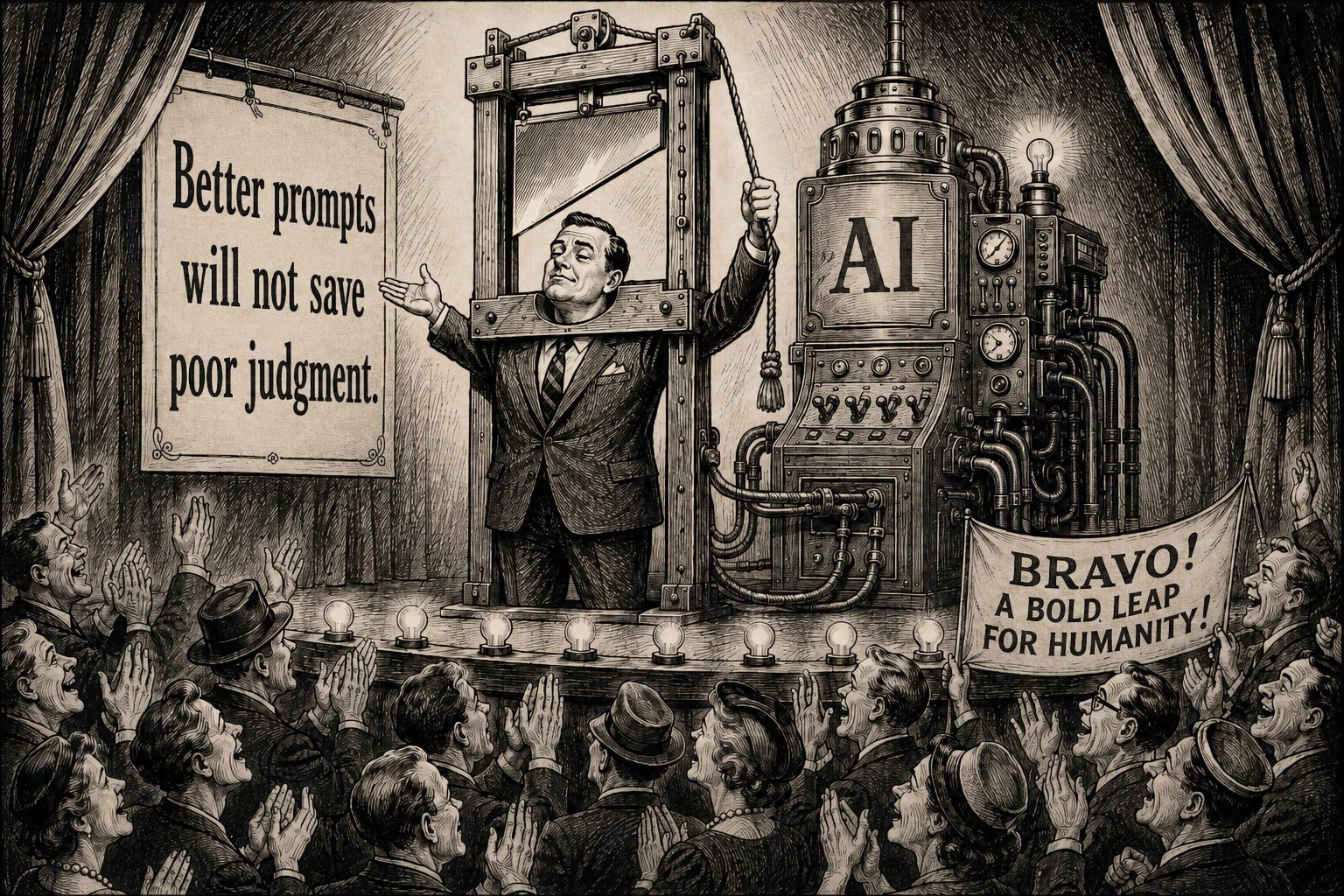
We have this idea that experts are like beacons of light that show the path to greatness. We have all sorts of so-called “experts” on AI: some are optimistic about the trends and possibilities of this wondrous technology; others are pessimistic. This is precisely why reconciling both sides – the apocalyptic and the optimistic – becomes an important step if we truly want to move forward.
In the last articles we have been addressing some issues brought up by the film The AI Doc: Or How I Became An Apocaloptimist by Daniel Roher and Charlie Tyrell (link where you can view it). My take on the issues started with “In Regard to AI: Fear is a Warning, not a Guide to Action” (link). The film rattled me in different directions… and this will be my last stand on an important aspect of AI and its vision of deploying it in our organizations and society in general. (Warning: this article has spoilers.)
In the film, first the apocalyptic perspective is presented by a selected few experts. This leaves Daniel Roher with a dread feeling right when he is expecting his firstborn. Then he goes and interviews with very prominent experts and leaders of the AI industry that expand the optimistic perspective and challenge the first catastrophic outlook:
“I feel more empowered (…) more confident to learn something today… We’re gonna become superhumans because we have super AIs.”
─ Jensen Huang, Co-Founder, President & CEO, NVIDIA
“This is just the beginning of an explosion. Humans and AI collaborating to solve really important problems.”
─ Eric Schmidt, Former CEO & Chair, Google
“It’s gonna be really important for things like drug discovery and understanding disease. I think we could cure most diseases within the next decade or two if AI drug design works.”
─ Demis Hassabis, Co-founder & CEO, Google DeepMind; Nobel Prize in Chemistry 2024.
“It [AI] is here to liberate us from routine jobs. It is here to remind us what is it that makes us humans.”
─ Kai-Fu Lee, Chairman & CEO Sinovation Ventures
These are not foolish men. They are brilliant experts. But brilliance in a domain is not the same as wisdom about human nature.
I totally agree with the latter part, but maybe in a different light from what Mr. Lee is implying. Within all positive and optimistic possibilities, lies the uncomfortable inconvenience of safety, not due to the AI per se, but because of us humans.
The truth we keep avoiding and not understanding is that in all the world, the most dangerous and evil reality is embedded in human nature. That is what usually gets out of control and derails our best intentions and efforts. Thinking we can put guardrails on our nature is what is truly childish and naïve.
Nevertheless, safety is an important issue. Let me share a clip from an interview given by the CEO of the Claude model: Daniela Amodei, Co-Founder and President of Anthropic: Building AI the Right Way
(watch the safety section until 00:16:40)
In it she states regarding her vision of safety:
“The kind of highest level framing is just taking a form of radical responsibility for the technology that we’re developing. […] What if I really tried to think through all of the ways that this could go wrong? What if I could think about what all the unintended externalities are, and really just kind of tried in advance to prevent some of those from happening?”
From this interview some may feel “that sounds so reasonable; at least some are thinking-through safety”. To think we can avoid blind spots in our reasoning and training or in safely deploying these models to the general public is ludicrous. There is no amount of safeguard revisions that can circle around human nature when it is used by people integrating AI in businesses and processes for advancing personal agendas and objectives. At that point, “radical responsibility” risks becoming less of a concrete safeguard and more of a noble intention — closer to wishful thinking than an achievable standard.
“Nay, fly to altars; there they’ll talk you dead;
For fools rush in where angels fear to tread.”
─ Alexander Pope, An Essay on Criticism
Safety work matters, but it cannot substitute for the moral formation of the people who will deploy and use AI. If you give extraordinary power to someone without character, humility, or discernment, you have not empowered intelligence; you have empowered danger.
On an aside note, Anthropic’s positioning on safety is more a marketing strategy playbook than a structural corporate vision and mission. For a take on this issue you can read my article: Why AI Blackmailed Kyle to Survive? <link>
On our last article, we envisioned AI models to be an army of experts at the command of the user (“I would challenge you to a battle of wits, but I see you are unarmed” <link>). If those experts who are modeling AI are no experts on human behavior or do not have the ethical and leadership skills required to handle an “army” of the caliber of AI, how can we expect other users less knowledgeable to wield this formidable tool?
We don’t need to stop AI development. It’s impossible. We cannot set guardrails on our nature; it’s not viable.
We need to upscale ourselves, and we need to do it now.

Final note and recommendation
It goes beyond this column and our article to go deeper into the development of the character we need to embark on the transformation we require to face the challenges of AI in our world. Make no mistake, it is an individual undertaking, not a social or legal reform… but if many of us do transform our ways, then social and legal reform will come.
There is a series of articles I wrote in Spanish a couple of years ago: Cirugía de Corazón Abierto (EN: Open Heart Surgery). I will start translating them this week. Permit me to share an article I wrote on precisely the subject of “radical responsibility” in our lives: The Full Power of Being [Part 1] <link>.