

We are distracted from the real issues of AI
Hopefully we can bring the main issues to social discourse before the poles of left and right distort and debunk our understanding of what is the right course of action.

Si quieres leer o compartir este Artículo en Español <LINK>
Karen Hao’s book “Empire of AI” presses a fundamental key from an insider’s perspective: it forces a hard look at how the AI industry is being envisioned – and, more importantly, at the warning signs being ignored. And no, these are not the apocalyptic scenarios so often announced.
From the wide range of issues Hao examines, I want to focus on one in particular: the “singularity-like gravitational pull” that large AI companies are already exerting on lawmakers and governments around the world.
First: let us look back to see a similar circumstance
Laws that attempt to bring order amid exponential growth often arrive too late: when power is already consolidated and the victims have piled up in exorbitant numbers.
In 1862 the huge unexplored and wild disarray of the west in the U.S. demanded to be civilized, it would have taken a hundred years to do so. So, the government passed the Homestead Act (May 1862), this law was the starting shot that launched the famous scene we have of the conquest of the west when thousands of Americans and immigrants raced to acquire 160 acres of free land which were offered to any willing to move West, farm it, and “improve” it for five years.
The need to conquer the “wild west” required a supply line from the northern east. Here is where the Pacific Railway Act (1862) was passed by no other than Abraham Lincoln. With it, this act made two things possible: the development of the north into an industrial power – giving millions of acres of free land to railroad companies, along with government bonds per mile of track laid and higher payouts for difficult terrain – which incentivized dishonesty and corruption. This legal framework for the railroad corporations authorized them to take land even if it belonged to tribes, without negotiation and it provided legal immunity to railroad companies during construction.
Two main corporations grew out of this opportunity: Central Pacific Railroad and Union Pacific Railroad. It did not matter what injustice, calamity or liability they created or caused; no one could take them to court or get any justice until the beginning the railroad-safety laws – for example, the Railroad Safety Appliance Act of 1893.
All injustices and disarray concerning Indian tribes, the unlawful behavior of the west, and the innumerable stories from lack of justice in the great USA sprang from this period.
The “Empire of AI” is the sunrise of a similar scenario
Karen Hao makes a compelling argument for the disproportionate power AI corporations are amassing, and the influence they are gaining over governments across the entire political spectrum. I summarize some of her arguments for you:
The major AI companies operate as modern-day “empires.”
They act on a planetary scale, reshaping rules to secure access to resources – data, energy, water, land, and labor. Their influence over politics and geopolitics continues to grow.The ‘AI empires’ extract resources without meaningful compensation.
They harvest public data and intellectual property without individual consent, while relying on underpaid labor in places like Kenya, Colombia, Uruguay, and South Africa to train their models.These AI corporations consume extraordinary amounts of energy and water, and generate pollution.
The expansion of data centers is driving global energy demand at an unprecedented pace. Some are even being built in regions already facing freshwater scarcity, draining public supplies. Their 24/7 operations increase air pollution through heavy dependence on fast, fossil-fuel-based energy production.They exert direct influence over lawmakers and governments.
Through investments, lobbying, and strategic relationships, they secure preferential treatment — to the extent that governments announce new data centers as “positive investments,” even when they worsen local crises.The absorption of critical human talent.
The ‘AI empires’ have drawn in much of the world-class AI research talent that once worked in universities, concentrating knowledge production inside private corporations for their own strategic and economic interests.
A word of caution: it is not a simple matter to judge –much less to attempt to restrain– the excessive power AI corporations are accumulating, if only because geopolitical tensions have not been this strained since the late 19th century. (Please check my article on this subject in “The Truth Has Roots” <LINK>.
A divided culture cannot govern its own power
In 1862, a country blinded by expansion and divided by internal conflict allowed new empires to grow unchecked. Rails were laid, the west was developed, and new powers emerged and grew at the shadow of division and polarization. Today our world is not divided so much by national delimitations, but by corporate and markets interest and economic growth –without mentioning the cultural and geopolitical tensions. The same blindness that allowed those empires to grow in the past is present in today’s world.
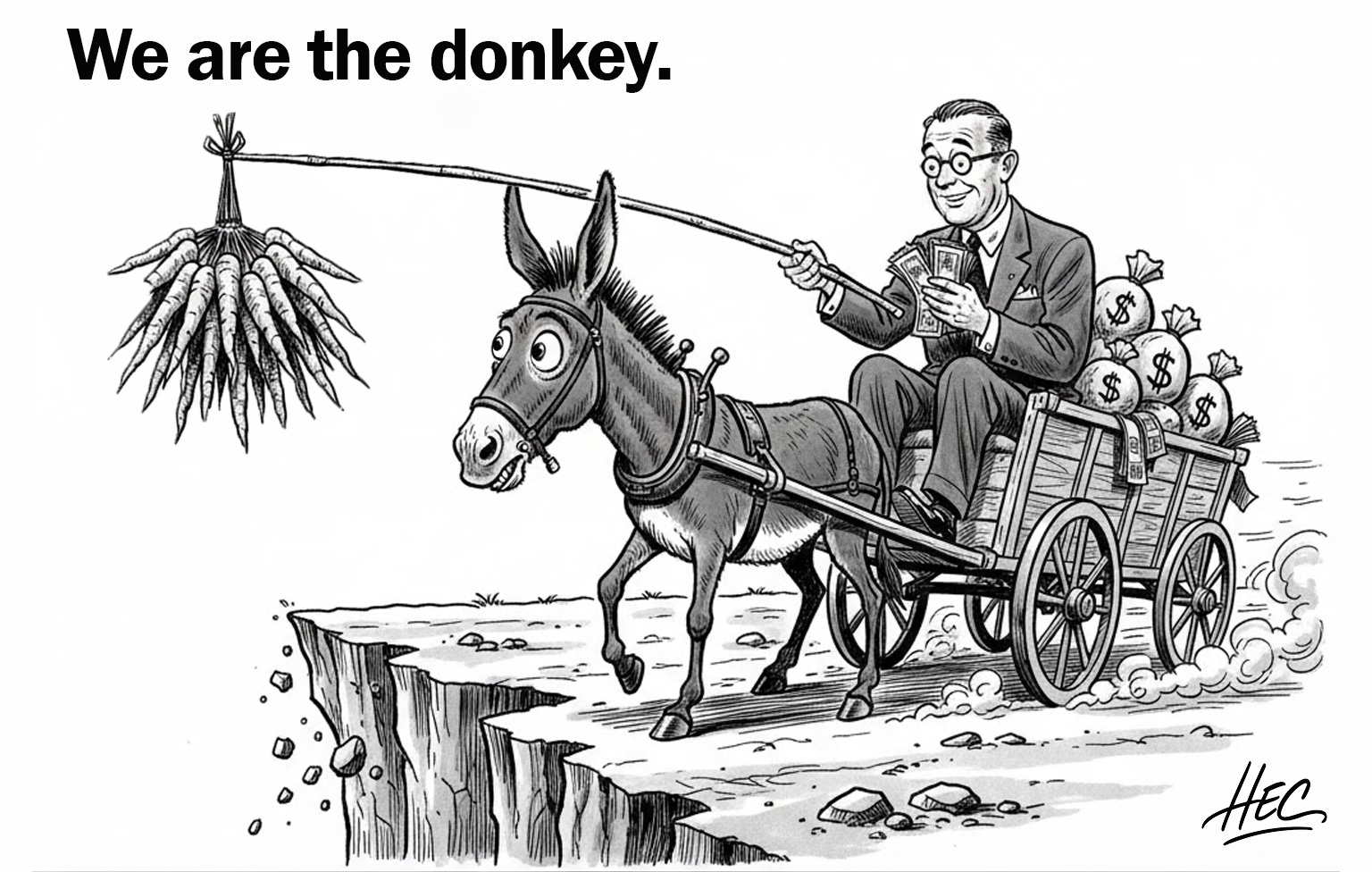
Today we are distracted in the same way. We argue about the wrong things while the unintended engines of power consolidate without friction. And just as in 1862, we – ordinary citizens, not the powerful l– are the ones pulling the cart forward, chasing the carrots we ourselves crave.
The question is not whether AI will lead us to a precipice.
The question is whether we will have the clarity to see it
and the courage to stop walking.
