

Will Norton AI's web browser be a disruptor in the web-search industry?

Puedes leer o compartir este Artículo en Español <link>
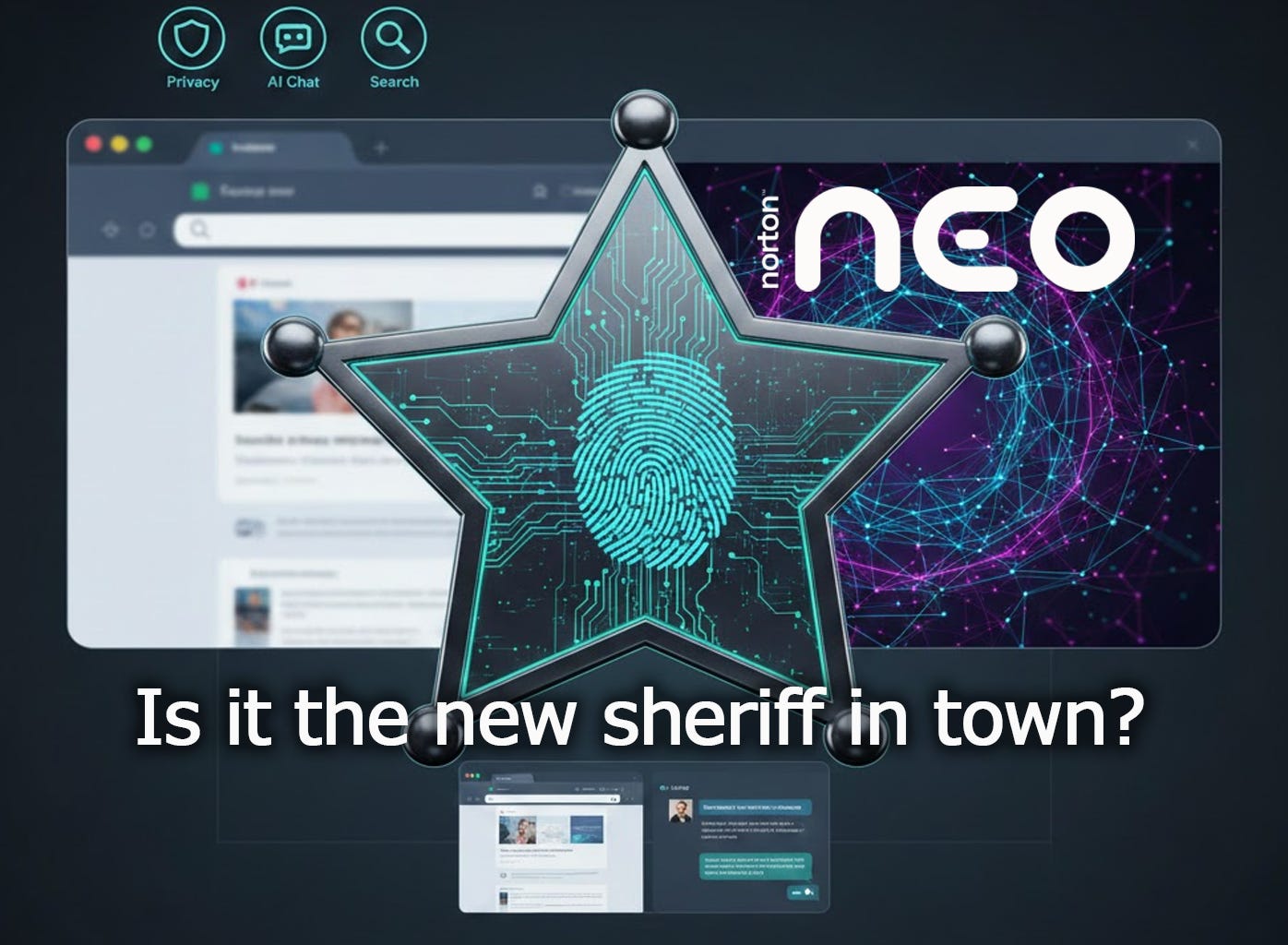
If you aren’t aware, our column has taken a new detour, we exposed the how and why in a short article titled “Adaptation Is a Virtue” <link>.
The present article is the first in a series of curated content – articles, news, innovation, adaptive technology – we do on the subject of artificial intelligence.
If anyone doubts that AI is going to invade every industry, no matter how big the player behind it is, they are in for a surprise. One of the biggest technological players ever is Google, and its search engine exemplifies its initial mission from 1998: “To organize the world’s information and make it universally accessible and useful.” AI’s vision may be very close to Google’s, so both are in competition for the same overall market. There’s no single “AI vs. Google for info” metric that compares them apples-to-apples. But Google’s claim that it processes 5 trillion searches per year (Search Engine Land) versus OpenAI affirmation that ChatGPT has 700+ million weekly active users (OpenAI), makes it clear they are competing for the same market share. By May 2024 Google launched “AI Overviews” including the AI mode as an option in Google Search.
As much as I have used it, I get the sense that Google is like an octopus trying to cover all available options it can impact in an attempt to fill any need before a competitor springs up. But can it?
Norton NEO – a new AI architecture web browser
Gen Digital is the giant behind the well-known security brand Norton; which is associated with computer and online security software. Norton positions Neo as “AI-native” by putting three layers at the core: classic search, generative AI assistance, and built-in security – rather than treating AI and protection as bolt-on features. The claim is bold; but is it a marketing strategy or a qualitative innovation in web browsing? And more importantly, how does it compare with the giants from Microsoft and Google, Edge and Chrome?
What’s different in practice between them?
I ran the same prompt through all three AI models and compiled the following aggregated comparison:
1) How you get answers
Norton Neo: Designed for an “ask a question → get an answer + sources” workflow; i.e., fewer blue links and more conversational retrieval.
Chrome (with Google Search): Best when you want conventional SERP (Search Engine Results Page) control: filters, multiple sources, fast link-scanning, and a workflow where you already “think in Google.” (Chrome lets you change the default engine.)
Edge (with Bing and Copilot features): Microsoft is pushing a combined “search/chat/navigation” experience via a Copilot-style interface.
2) Privacy & safety positioning
Norton Neo: explicitly positioned as “safe AI-native browsing” with Norton/Gen security DNA as a core differentiator.
Chrome / Edge: Both offer strong sandboxing/security in modern browsers, but their primary value propositions are ecosystem integration and performance; their privacy posture depends heavily on account sign-ins, settings, and default services.
3) Ecosystem advantage (the real deciding factor)
Chrome: tightest integration with Google accounts/services.
Edge: tightest integration with Windows/Microsoft 365, and the AI layer is increasingly native to the browser.
Neo: An “AI command center + safety” first approach; ecosystem depth is newer (Neo was released globally for free on December 2, 2025).
My imput
I’ve been using NEO for over a week with excellent results. There are some setbacks that I imagine are due to the new adaptability and usage-training that is still going on. I also found some advantages:
At times it doesn’t respond, and I have to ask twice. I imagine these are glitches that will be resolved with additional training.
Neo relies on personalization (“it learns what matters to you”). That is an overall trait of all AI models. Suggestions and navigation will be an important part of NEO’s value proposition. However, I haven’t been using it long enough to truly validate this thoroughly.
For Neo, I didn’t find – within official sources – a clear, comprehensive equivalent to the kind of “policy management” you get with Edge or Chrome. (This doesn’t prove it doesn’t exist, but it does suggest it isn’t as standardized or publicly documented as it is for Edge/Chrome.)
The new browser has a dual side-by-side work environment: AI chat or the browser. This allows you to chat to create a text and include it in the browser – such as webmail, a blog or WhatsApp Web without changing tabs.
It also has smart tab grouping, which helps me keep my tabs organized by segments or areas. I maintain many tabs open at a given time.
NEO is user-friendly and has interesting features to view and summarize a page without entering it. It also has the same “search tabs” feature as Google.
NEO has access to the Chrome Web Store for extensions, and you can add them to the browser. For instance, I have used the Google Translator extension and it works OK; however, NEO does not guarantee 100% compatibility. I would love to hear from you if it works properly for your needs.
Norton NEO should not be viewed simply as another LLM model like Gemini or ChatGPT. It is a web browser whose architecture is built around AI. Let me share how I used the NEO web browser: I regularly search for sources of information in my work and writing... I’ve been using it to contrast and compare with ChatGPT and Gemini. It seems to evaluate searches in layers, similar to Gemini, but at times delivers the response like ChatGPT—in order of significance and relevance. I found it useful and complementary.
For now, I believe NEO is going to capture a share of the mainstream web browser market. We’ll see if it evolves with new options and innovates in different segments; if so, we will see NEO taking an even larger share of the web browser market.

Here a tutorial for you

If you are interested: here is a link to download Norton NEO for your computer or mobile <link>
