

Without Ethics, Life Becomes Unlivable
The existential reason for our column.
Puedes leer o compartir este Artículo en Español <LINK>
This article was translated with the assitance of ChatGPT.
Existence by itself is not enough for a human being;
living requires much more than simply being alive.
The fruit of a well-lived life is prosperity, joy, and peace.
That is what we long for. And without ethics —which is nothing less than orientation with a purpose that completes us— what emerges is anxiety, discontent, and a deep inner emptiness. Tim Keller, in Making Sense of God, puts it starkly: “Most people take years to discover how dissatisfied they are with themselves.” It often takes a moment of overwhelming joy or a moment of hitting bottom to realize the emptiness we carry within —and then, dare to face the big questions:
“What is the meaning of all this?”
“What makes life truly fulfilling?”
“What is real and true?”
Answering them requires time, perspective, and experience. Hardship, pain, loss, and tragedy will reach all of us. That is why, around age forty, the classic threshold of the ‘existential crisis’ appears: the point at which these questions can no longer be postponed.
And if confronting these questions was already difficult, it is even more so now, in an age where time feels compressed and growing up has become a rare occurrence.
Our world demands we “grow up fast”
Our human experience has accelerated —especially since the 20th century. Generational shifts in values, identity, and behavior that once took forty years now happen in under a decade.
Meanwhile, emotional and psychological maturity is delayed for social and cultural reasons; today, adolescence and stretches well into the twenties, if not longer.
This weakens social and political maturity. While empty promises from politicians —appealing to our lowest instincts— spread faster, planting empty expectations that inevitably lead to discontent and frustration in the short and medium term.
And in the midst of this acceleration, we have introduced AI into every sphere: social, political, corporate, economic, and personal. It now functions like a turbocharger, promising to propel us faster toward our goals. But here is the real problem: we lack direction, we lack a purpose that grounds us, we lack accountability. And without these, no tool —no matter how extraordinary— can lead us toward prosperity, joy, and peace… realities that reach far deeper, and endure far longer, than happiness.
You are the “i” in artificial intelligence
If you look closely at what AI really is (I invite you to read my article AI uses a simple attribute of our brain <LINK>), you will see that it is essentially an extremely sophisticated probability calculator. Do not be fooled by grand speeches: no one knows exactly how it produces its answers. What we do know is that these systems operate through statistical calculations estimating the probability of a plausible outcome.
But mathematics and statistics cannot originate purpose. If, in the 17th century, we had given a model access to all available knowledge, it still would not have discovered the Laws of Motion —not because it lacked data, but because it lacks what makes discovery possible: a mind guided by a question, by purpose, by intuition.
The same is true for The Special Theory of Relativity of Einstein.
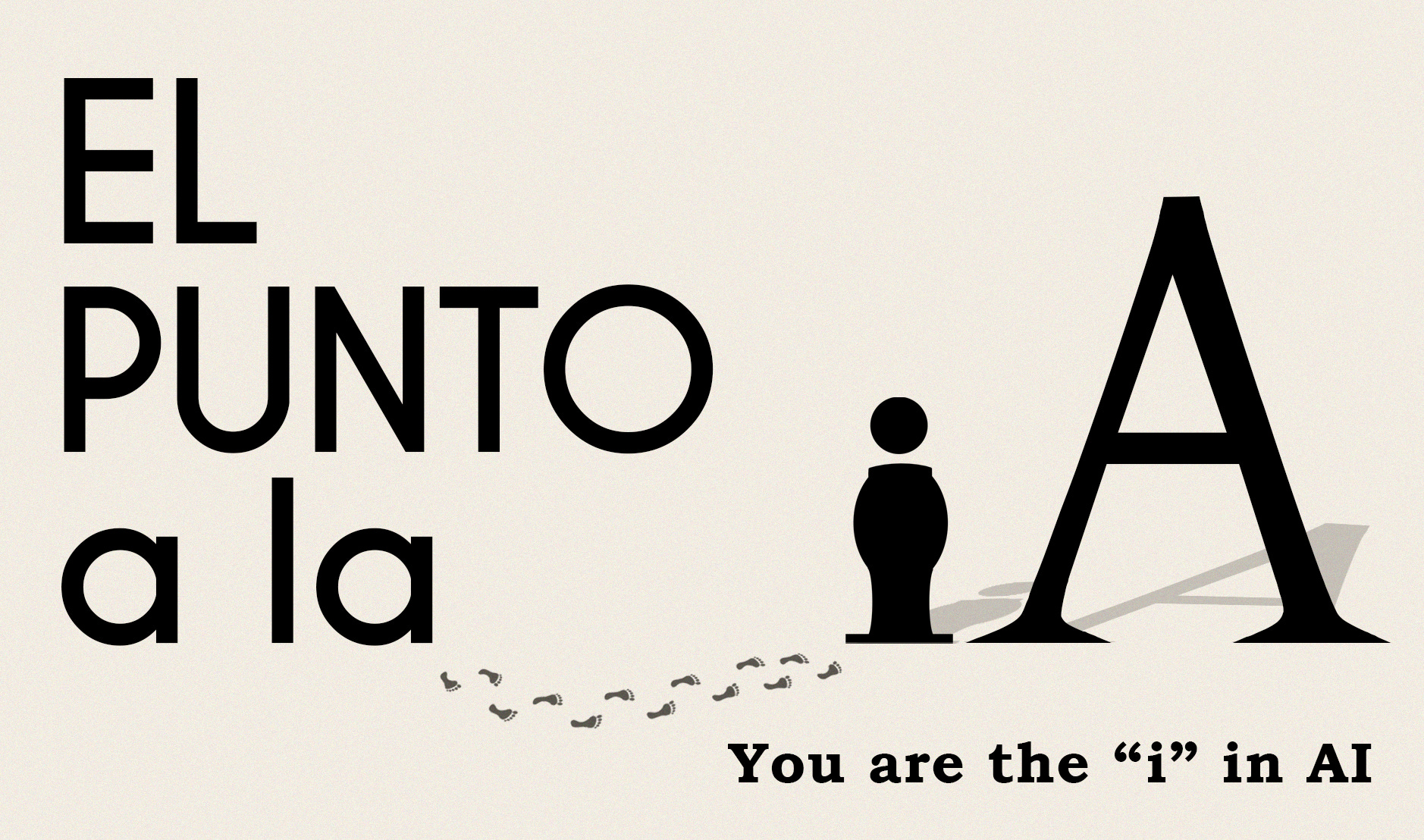
Purpose, direction, and ethics come from us. We are the ones wielding this extraordinary tool. Which is why we must become more than what we have been —and put, quite literally, the dot on the “i” of AI (EL PUNTO a la “i” in AI).
Life is much more than existing
The existential restlessness that permeates modern humanity —recognized only by those who experience extreme tension or by those who dare to examine their lives honestly— cannot be ignored if we are to survive the challenges AI will magnify.
We need to “pause” in the midst of daily urgency.
Recover perspective.
Reorder our values.
No tool can replace a life oriented toward what truly matters.
Ethics is not a moral luxury; it is the oxygen that makes fullness of life possible.
So before you ask what AI can do for the world, ask yourself: “What will your ethics do with it?” Because if your inner compass is not pointing north, no map —human or artificial— will correct your course.
Life is far more than mere existence.
But without ethics, living collapses into an unlivable chaos.

